
The Ultimate O-Ring Selection Guide: How to Choose the Right Seal for Your Application
In the world of industrial manufacturing and mechanical engineering, a single component can stand between flawless operation and a catastrophic leak. That component is often the humble O-ring. As a leading high-performance seal provider, VanyTol understands that selecting the correct O-ring is a science.
Whether you are looking for standard industrial seals or custom solutions, this comprehensive guide will walk you through everything you need to know about O-ring dimensions, material selection, and optimization for your specific application.
1. Understanding O-Ring Dimensions: ID, OD, and CS
Before ordering an O-ring, you must accurately determine its geometry. An O-ring size is defined by three critical measurements: Inner Diameter (ID), Outer Diameter (OD), and Cross Section (CS).

Figure 1: Standard O-Ring Dimension Metrics
When measuring your groove or an existing seal, remember the core formula:
OD = ID + (2 × CS)
Using precision calipers is essential, as even a fraction of a millimeter variance can lead to improper seating and eventual pressure failure. To ensure perfect compatibility, you can check our standard O-ring size charts before purchasing.
2. Choosing the Right O-Ring Material
O-rings operate in extreme environments involving chemical exposure, intense pressure, and wild temperature fluctuations. Choosing the wrong compound will lead to rapid degradation—a process known as chemical swelling or thermal hardening.
Below is a breakdown of the most common industrial O-ring materials offered by VanyTol:
| Material Type | Temperature Range | Best Suited For | Avoid Using With |
|---|---|---|---|
| NBR (Nitrile) | -40°C to 120°C | Petroleum oils, water, hydraulic fluids | Ozone, UV light, automotive brake fluid |
| Viton™ / FKM | -26°C to 230°C | High temperatures, aggressive chemicals, fuels | Ketones (Acetone), steam, amines |
| Silicone (VMQ) | -60°C to 225°C | Food/Medical applications, dry heat, ozone | Concentrated acids, high-shear dynamic seals |
| EPDM | -55°C to 150°C | Steam, outdoor environment (UV/Ozone), water | Petroleum-based oils, greasy environments |
3. How O-Rings Work: The Sealing Principle
To prevent premature seal failure, it helps to understand the mechanics of compression. An O-ring is designed to be seated in a groove and compressed upon assembly.
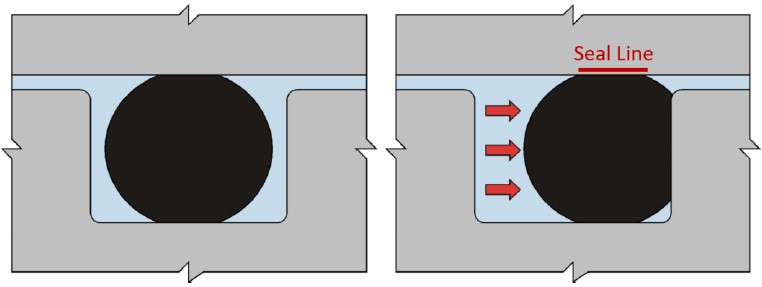
Figure 2: The Sealing Principle – Compression and Fluid Pressure Performance
As fluid or gas pressure increases within the system, it pushes the O-ring against the opposite side of the groove, forcing it to deform. This deformation creates a highly concentrated “Seal Line” (as shown in the schematic above) that completely blocks the leak path.
If the system pressure exceeds the material’s structural limits, or if the clearance gap is too wide, the rubber will experience “extrusion failure”, tearing the seal apart.
4. Why Partner with VanyTol for Your Sealing Solutions?
At VanyTol, we don’t just sell rubber rings; we engineer reliability. Our manufacturing facilities strictly adhere to international quality protocols, ensuring that every batch exhibits excellent tensile strength and minimal compression set.
- Global Standards Compliance: Our O-rings are designed to meet standards such as AS568, ISO 3601, and DIN 3771.
- Custom Formulations: Need specific shore hardness (Durometer) or chemical resistance? Our team can customize compounds tailored to your operational ecosystem.
- Rigorous Quality Control: Every seal undergoes automated optical inspection to eliminate surface defects before shipping.
Conclusion & Next Steps
Choosing the perfect seal doesn’t have to be a guessing game. By calculating precise dimensions, matching the compound to your chemical environment, and trusting a vetted manufacturer like VanyTol, you can secure your equipment’s longevity.
Ready to secure your industrial systems? Contact our engineering team today for an instant quote, or browse our Full O-Ring Catalog to find your perfect fit.